For some Māori players, Māori Football Aotearoa is the first space where tikanga and football braid together. For others, it becomes a lifelong memory that shapes their playing career long after the event fades.
For Ariana Gray, that memory began at 14.
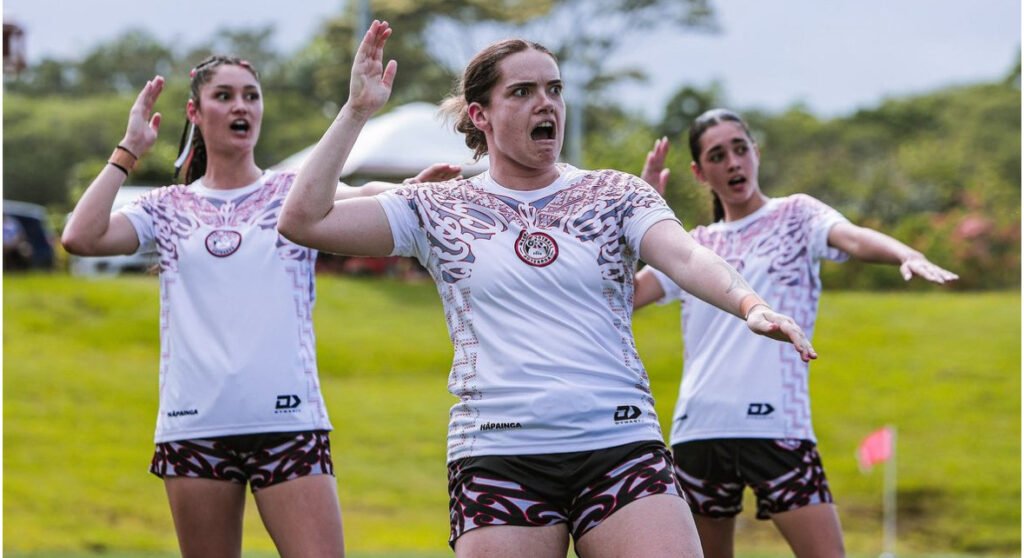
“I first learned the haka when I was 14 or 15,” she recalls. “Now I’m 22 and I still remember it word for word.”
“I always want to do everything right, so there’s definitely nerves. The haka makes me feel connected, but also very nervous. It’s that feeling of wanting to get it perfect.”
That nervous energy, Ariana explained, is part of what makes the performance so powerful:
“We were shown videos of previous years and the girls always got faster during the haka, and part of it was nerves, but also that energy, that adrenaline. All the voices start blending into one big, powerful voice.”
That longevity and impact matters. It proves that the cultural component of Māori Football is not ornamental or symbolic, it is embodied, remembered and carried forward.
For the young players in North v South, haka represents both challenge and hype. It is the moment where football intersects with identity, where the competitive instinct meets whakapapa, and where vulnerability becomes strength.
“When it’s your first time, you’re doing it against your mates on the other side of the halfway line,” Ariana says. “It brings the next level of hype and mana to it, which is a very special feeling.”
It’s also where belonging begins.
Many Māori players grow up in club or academy systems where culture is either invisible or optional. Māori Football flips that hierarchy, here, at North vs South U-16 and U-18 women’s camp, Māori culture comes first, football second.
This inversion shapes confidence. It provides a cultural baseline that carries into future environments, whether domestic, professional or international. The haka becomes a reference point for courage, unity and emotional regulation under pressure, all crucial components of football performance.
It also creates lifelong bonds.
The vulnerability of performing haka together, of te reo Māori spoken freely, of tikanga held seriously, becomes part of the player’s internal landscape. The football may end at full time, but the kaupapa continues.
“I think a lot of girls come into MFA and are disconnected feel whakamaa coming into spaces like this. They feel like they don’t belong or they’re stuck between two places.”
“Some of the girls haven’t stepped into this part of their identity before, so North v South is a good space for them to feel comfortable to explore that. If you’re already comfortable in football, then adding Te Ao Māori feels less scary.”
Part of the kaupapa is breaking down whakamaa, the self-consciousness or anxiety that stops many rangatahi from accessing their Māoritanga:
Watching younger players move through that emotional arc — from hesitation to pride — is one of the reasons Ariana continues to be part of the programme:
“I see myself reflected in the new girls. I was exactly like they are here — nervous, not sure if I was doing things right, but wanting to learn. Over time, you get more confident, and it’s cool seeing that happen for other Māori girls in their identity and in football.”
For Māori Football Aotearoa, this is the measure of success: not only whether the team plays well, but whether each player leaves with something that remains — identity, memory, confidence, whanaungatanga, mana.
The haka stays with you. And that is the point.
Ends
Story by MFA Media
Image courtesy Ariana Gray